
 The origins of Reiki are somewhat mysterious, and much of the information that is available about Reiki is either contradictory or not validated by historical reference. What most sources seem to agree upon is this:
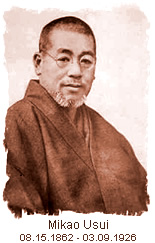
Late in the nineteenth century, Mikao Usui, a Japanese scholar, began an intensive study of energetic healing and spiritual practices. His quest led him to research texts created by Tibetan monks over the course of many centuries. Usui recovered sacred symbols and mantras.
A key part of Usui’s learning was a mystical experience he encountered upon completing a 21 day fast and meditation on Mount Kurama in Japan. He saw a shining light that struck him at his third eye. Usui found himself in a state of expanded consciousness where he could see energy in the form of bubbles of rainbow colored light.
Ultimately, in another bright light, he recognized the symbols that he had been studying from the Tibetan texts glowing in golden light. Simultaneously the meaning and purpose for the symbols became clear to him. Upon descending the mountain in his greatly expanded state Usui stubbed his toe causing it to bleed and throb. He held his hands around his foot and the bleeding and pain stopped immediately. This was a validation of the powerful healing force that he was charged with.
Mikao Usui worked for seven years healing in the slums of Kyoto. He became discouraged that though he could heal peoples physical bodies, they remained trapped in their patterns recreating disease. He created the Reiki principles.
Usui realized that in order for someone to heal they must first want the healing and then ask for it. He also recognized that there must be some form of exchange of energy between healer and receiver. He realized that payment is necessary.
Ultimately, Mikao Usui trained over 2000 practitioners before he died in 1926. At least 16 of those practitioners he trained as Reiki Masters. Dr. Chujiro Hayashi, one of those Reiki Masters, utilized Reiki at his three healing clinics in Japan. The practice of Reiki moved to the west when Mrs. Hawayo Takata from Hawaii received Reiki training from Dr. Hayashi.
Compelling evidence connects the Reiki lineage of healing masters to a much older lineage of healing masters from the Bön tradition of Tibet. Bön practices are said to have been developed and passed uninterrupted from master to student for 18,000 years. The modern roots of Reiki are believed to have originated with Lama Tsewang Rikdzen about 500 BC when healing practices from the established oral tradition were committed to texts. Present day practitioners can all trace their teacher lineage to Mikao Usui who developed the practice as we use it today. Usui Sensei is believed to have tirelessly researched energy healing and brought his discoveries to Japan early in the previous century.
Lama Tsewang Rikdzen of the Bön lineage has a very extensive biography, but as far as is known it has not been translated into English. However, included below are a few very brief and very general details about him.
Lama Tsewang Rikdzin (Lama is a religious master or guru venerated by his students as an authentic embodiment of the Buddhist teachings, and Rikdzin is one who holds a high degree of knowledge and wisdom) was an historical person who was one of twin sons born to Lama Drenpa Namkha. His mother was Öden Barma, who was a Brahmin from India. His twin brother is known as Pema Thongdrol by the Bonpos and as Guru Padmasambhava by Buddhists. Both Lama Drenpa Namkha and Khandro Öden Barma were very realized practitioners.
Lama Tsewang Rikdzin’s life story is told in four volumes of texts. He is most widely practiced as a long life yidam (Yidam is an enlightened deity whose specific qualities and form are meditated upon), as one of his powers was in extending his lifespan. Some texts say that he lived over 500 years, others say that he lived over 800 years. He practiced with his consort, Khandro Nyima Öbar. He was a realized practitioner of Dzogchen (Dzogchen aka Great Perfection, is the ultimate of all the 84,000 teachings, the realization of Buddha Samantabhadra) as well as having mastery of tantric practice. (The translation about Lama Tsewang Rikdzin is by Raven Cypress Wood of Ligmincha Institute)